
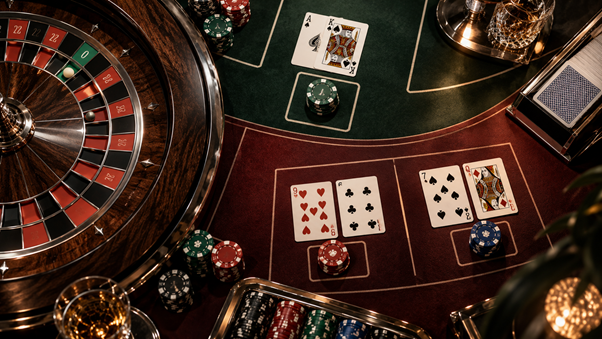
The house edge is a mathematical estimate of the casino’s average advantage over a very large number of wagers. The table games at a casino each carry their own percentage, and blackjack, roulette and baccarat produce different theoretical returns even when stakes and session time appear similar. Their percentages arise from different rules: blackjack depends partly on player decisions, roulette is driven by the wheel layout, and baccarat changes according to the selected bet.
A lower percentage describes the long-run relationship between total stakes and expected loss under the stated rules. Actual outcomes can move sharply in either direction, especially across a small number of hands or spins.
House edge is a long-run measure
If a game has a 2% house edge, the mathematical expectation is an average loss of $2 for each $100 wagered over an extremely large sample. One session may finish ahead, another may use the full playing budget, and neither result changes the underlying percentage.
Turnover matters more than the opening balance when applying the concept. A player who repeatedly wagers the same funds can generate several hundred dollars of turnover from a smaller deposit. Expected loss is calculated against cumulative wagers.
The estimate also assumes the published game rules are followed. Side bets, unusual payouts, optional features and suboptimal decisions can produce a different figure from the headline percentage.
Blackjack changes with rules and decisions
Blackjack is unusual because the player chooses to hit, stand, double, split or sometimes surrender. The house edge therefore depends on both the table rules and the strategy used for each hand.
Under favourable rules and accurate basic strategy, a conventional blackjack game can have a house edge below 1%. That figure rises when blackjack pays 6:5 instead of 3:2, the dealer hits soft 17, doubling is restricted, splitting rules are less flexible or the game uses other conditions that shift the balance.
Basic strategy is a decision chart that identifies the mathematically preferred action for a player total against the dealer’s visible card under a defined rule set. Using intuition instead can add avoidable cost. Standing too often on weak totals or passing on a favourable double changes the expected return.
The number of decks matters, but the complete rule set matters more. A six-deck table with good payout and dealer rules may be more favourable than a single-deck variation with a poor blackjack payout. Players need the full rules panel.
Blackjack details to check
Before playing, the useful questions are:
- Does a natural blackjack pay 3:2 or 6:5?
- Does the dealer stand or hit on soft 17?
- Can the player double after splitting?
- How many times may pairs be split?
- Is surrender available?
- Are side bets included by default?
Side bets carry a higher house edge in most cases, so combining them with every hand changes the overall expectation materially.
Roulette is set by the wheel
Roulette gives the player many wager types, but most bets on the same wheel share the same house edge. A straight-up number, a split, red or black and odd or even are all priced around the number of pockets and their payouts.
European roulette has 37 pockets: numbers 1 to 36 plus a single zero. A straight-up winning number pays 35 to 1. Because there are 37 possible outcomes, the standard house edge is about 2.70%.
American roulette adds a double-zero pocket, creating 38 outcomes while retaining the usual payouts. Its standard house edge is about 5.26%. The visual difference between one zero and two zeros is therefore significant despite the otherwise similar appearance.
Some roulette tables use la partage or en prison rules on even-money wagers when zero appears. These rules can reduce the effective house edge on qualifying bets.
Choosing a more complicated layout wager changes volatility and hit frequency but stays linked to the same zero structure on a standard wheel.
Baccarat depends on the chosen bet
Baccarat usually asks the player to select Player, Banker or Tie. The dealing procedure then follows fixed drawing rules, so there are fewer decisions during the hand than in blackjack.
The Banker bet commonly has the lowest house edge, often around 1.06% when a 5% commission is charged on winning Banker wagers. The Player bet is commonly around 1.24%. These figures reflect the slightly different probabilities of the two hands under the drawing rules.
The Tie bet carries a much higher house edge in many versions. The exact percentage depends on the payout (8 to 1, 9 to 1 or another amount) and the probability of a tie occurring. The displayed return should be read alongside the frequency of the event.
Commission-free baccarat needs separate review. Some versions change the payout when Banker wins with a particular total. The title commission-free describes the fee structure, and the house edge requires a check of the full payout conditions.
Side bets such as pairs or bonus totals have their own probabilities and payouts, separate from the main Player or Banker wagers.
A direct comparison needs matching assumptions
| Game or bet | Typical long-run figure | Main variable to inspect |
| Blackjack main hand | Can be below 1% | Payout, dealer rules and decisions |
| Baccarat Banker | Commonly near 1.06% | Commission or altered payouts |
| Baccarat Player | Commonly near 1.24% | Version-specific drawing rules |
| European roulette | Commonly near 2.70% | Single-zero wheel |
| American roulette | Commonly near 5.26% | Double-zero wheel |
| Tie and side bets | Often materially higher | Exact probability and payout |
The comparison holds when the player follows the assumed blackjack strategy and keeps side bets separate. If decisions differ, the practical blackjack percentage can move above the table value.
Volatility is different from house edge
House edge describes expected cost over turnover. Volatility describes how widely results can fluctuate along the way. Two wagers can have similar house edges and produce very different session experiences.
Baccarat Banker and Player bets settle frequently at close to even money. A roulette straight-up number wins rarely with a larger payout. Blackjack outcomes include wins, losses, pushes, doubles, splits and natural blackjacks. These patterns affect balance swings even before the long-run edge becomes visible.
The practical choice should consider rules, pace, stake minimums and comfort with the format alongside the percentage.
Check the information screen
Two tables carrying the same broad game name can have different mathematics. The information panel should disclose payouts, dealer procedures, commission, wheel type and side-bet terms.
For blackjack, a basic-strategy reference should match the precise rules in use. For roulette, the wheel should be confirmed as single-zero, double-zero or another variant. For baccarat, the commission and special payout conditions should be clear before a wager is placed.
Return-to-player percentages, where published, are the complement of the house edge. A 2.70% edge corresponds to a 97.30% theoretical return. The figure remains a long-term average.
Use the percentage as a planning tool
An Australian player can record the table version, approximate edge, stake, planned rounds and maximum spend. This creates a more complete view than comparing percentages alone.
Blackjack can offer the lowest theoretical edge when rules are favourable and decisions follow correct strategy. Baccarat provides simple fixed procedures, with Banker and Player priced more favourably than Tie. Roulette is easy to read mathematically, with the single-zero wheel offering a lower edge than the double-zero version.
The final choice stays personal, but the comparison works best when the exact rules are inspected, main bets are separated from side bets, game speed is considered and cumulative turnover is used when estimating expected cost.